
*This is taken from a blog post over at my website Preserve Your Tree

Writing your own personal history is a valuable treasure that you can leave to your family, a lasting legacy. Future generations can look back and view your life, your thoughts and feelings, understand your time and experiences. They can get an accurate glimpse of what life was like for you . You may think “I have nothing worthwhile to say”, or “who cares about me?”, but that could not be further from the truth! “Ask yourself these questions – if your parents, grandparents, and other ancestors did not leave life histories, do you wish they had? Do you wish you could read about their lives? If so, it is likely for your descendants to feel the same way if you don’t. A record of your life can be a great gift to those who come after you. Words in print can be read and reread, pondered over, and returned to. The words your teenager rejects now may become clear and precious when he or she rereads them later in life.” (family Search Wiki). You could have a great influence on your ancestors, your trials and adversity and triumphs could help strengthen those who are reading, giving them hope and fortitude to carry on. Writing your history can also help you evaluate your life. As you write you can reflect on choices, desires, goals and things that help you define the direction you want to go in your life. Your personal history can be a blessing to yourself and others.
WHEN SHOULD I START?
NOW!! Don’t put it off until tomorrow, or say you will do it when you have the time, or when you retire, or have a day off. Busyness will always be an excuse, and oftentimes there will always be something that will tempt you to procrastinate. We don’t know our time on this earth, so do it before your time here is through.
“Too many times we stand aside
And let the waters slip away
‘Til what we put off ’til tomorrow
Has now become today…” (Garth Brooks, The River)
HOW SHOULD I START
How do you eat an elephant? One bite at a time. Start small. Your writing goals should be specific, realistic and achievable. Don’t take on too much all at once, or you may get frustrated. Perhaps you set a small goal of writing 1 hour a week. You could do it all in one sitting, or you could take 10-15 minutes a day . You find a workable goal for your personal situation. Some people set aside a specific time every day, some on a specific day of the week. Make this a priority, even if it is a few minutes. You will be blessed for your efforts.
“I DONT KNOW WHAT TO WRITE”
There are several places to start. Your Personal History isn’t limited. You can break it down however you want. You can do specific events by age (when I was 5 we got our first dog), you can do collective events in vague form (In High School I would go to the football games and hang out with my friends). You can remember places you went, people you met, important events, playing sports(or not playing sports), what your house was like, what your neighborhood was like. Anything that contributed to you being you! There are lots of great online resources to help you on this journey, to help trigger memories and give you ideas to write about.
JRNL.COM is a great online platform (it’s free, just register), and helps you organize your thoughts, has multiple journaling categories and their All About Me section has great questions to get you started.

#52STORIES: in 2017 Family Search launched its 52Stories project. The Idea behind this was What if you only had to write one story a week, and you could pick what you wrote about?
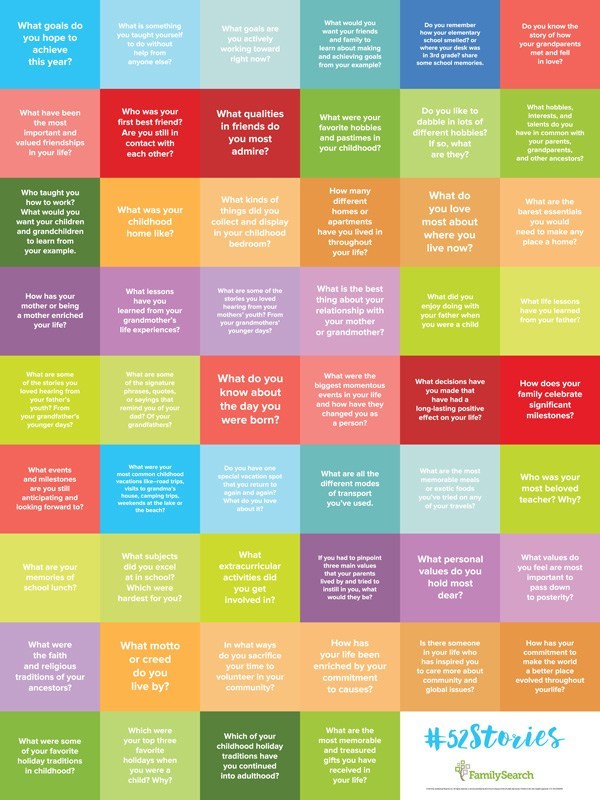
That’s 52 weekly ideas. They also had monthly themes with 12 questions in each theme, so there is 144 ideas for you to start on as well.
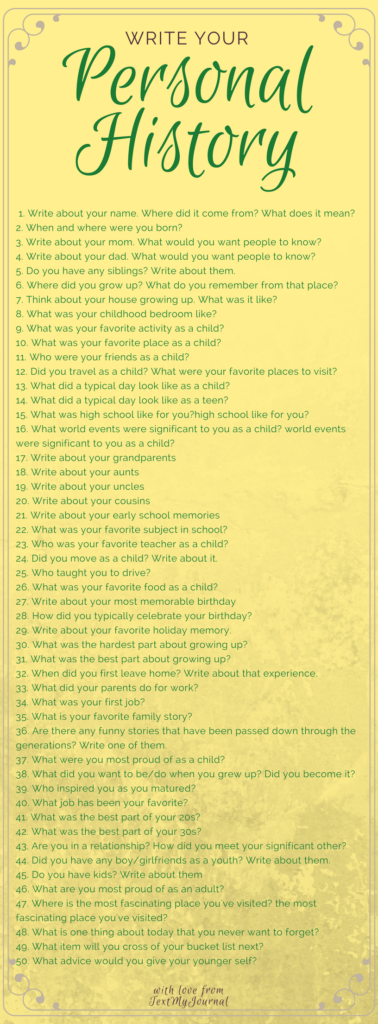
There are also these journal prompts that I found over at Text My Journal
HOW DO I DO IT?
Start writing!! Use your computer and whatever writing program you have (Word, pages, google docs etc). Organize in a folder in a way that makes sense to you . Write in a way that is comfortable to you. Dont stress about punctuation and grammar…write how you would talk! Dont feel like you have to start at the very beginning and make it a chronological event, start with an exciting time in your life, or an event that personally affected you. If you are inspired to write about something then do it! You can organize chronologically later down the road. Sometimes a memory may be triggered by a smell or a song or something you read…USE THAT! Be descriptive- talk about the colors and sounds and smells and describe how things looked. (The girl was wearing a sweater and pants and had brown hair vs. the young lady wearing the blue and pink butterfly sweater with denim pants and had curly brown hair that looked red in the sunlight). Always be truthful and honest, BUT be careful of sensitive subjects especially if it may involve, implicate or libel other people. Don’t be afraid to laugh at yourself, find humor in your life and situations, and don’t be afraid to write about your weaknesses as well as your strengths. Don’t be afraid to admit when you were mad, scared, depressed or angry, don’t be scared to admit to failure. Remember, this personal history isn’t just the All Hail and Glory to You show, this should be a TRUE representation of every facet of you. Good and bad.
Dont feel comfortable writing? Do a voice dictation or a video! In the age of unlimited technology there are many ways to record your history, orally. Almost everybody has a smart phone. Take a video, or download a voice recorder app. Not that tech savvy, or still living in the world of flip phone? You can order a mini digital recorder online and use that to record. Tell stories, sing songs, decribe what you see and how you are feeling. The downside to oral history is the medium on which you are recording can degrade over time if on a disk or CD. Go through your memory files once a year to make sure files are still good, and when you have time you can do a transcription of what you said into written word.
Make a scrapbook! There are many ways to do a scrapbook. Scrapbooks tend to be more of a visual representation, but in addition to written stories to go along with the pictures you have a great piece of personal history. Many people do digital scrapbooking. Sites like CANVA offer various free templates that you upload your pictures to and then save to your computer. If you choose to do a physical scrapbook, never use originals, always photocopy any documents or make copies of pictures. Make sure you use quality scrapbooking supplies, like acid free paper, special tape and adhesives. This is going to be your Magnum Opus, make sure it lasts.
IDEAS AND THINGS TO INCLUDE
Don’t feel like your personal history needs to be all just memories and stories. Include snippets of journal entries, photographs, scriptures or inspirational quotes, maps, copies of certificates, milestones, travel brochures, and even things like concert ticket stubs. When you look through your collection you want to really capture your essence, and you want any readers to feel like they see and know the real you.
DONT STOP!
When you think you are done, just remember…you aren’t. Every day that goes by is another opportunity to add to your family history. Keep Going!! I know this year everyone will have a chapter on “What I did during the Pandemic Shutdown”! There will always be births, deaths, marriages, trials and triumphs. Don’t stop recording because you think you may be finished with your story, there will always be things to write about.
Good luck on getting started on your personal history, and remember one bite and a time!
*as an amazon affiliate we may earn a small commission on any purchases made from this site.


